Mini-Splits vs. Traditional HVAC for Barn Wedding Venues
Converting a barn into a year-round wedding venue? We explain how we compare mini-splits and traditional HVAC to keep event barns comfortable in every season.
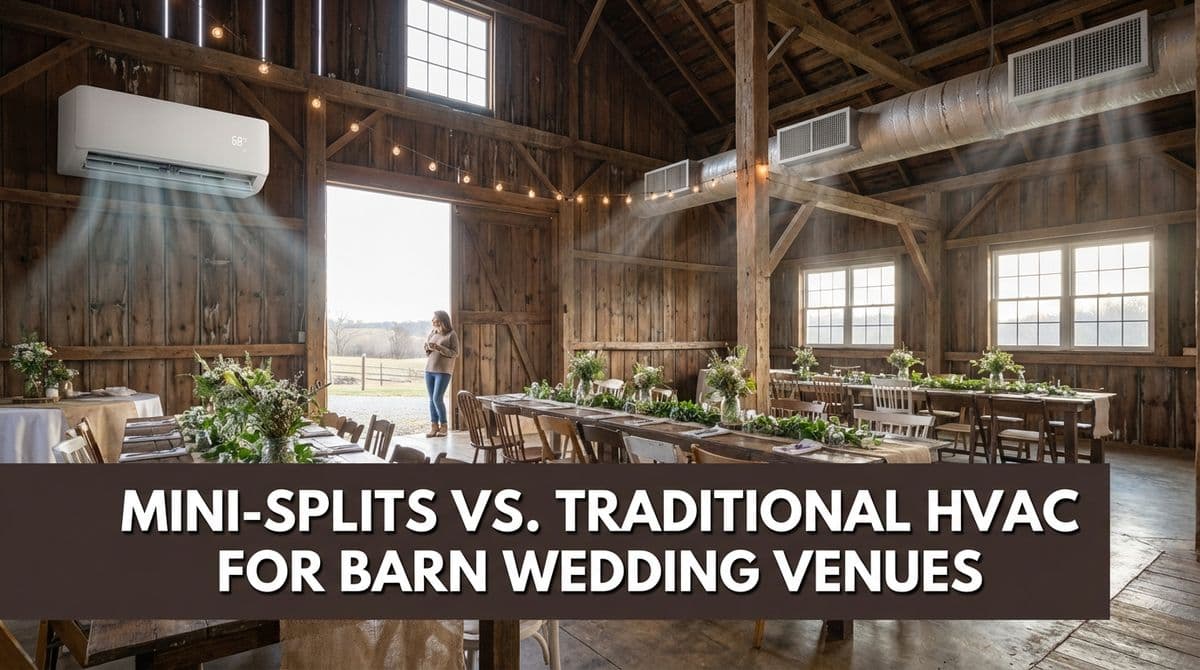
How a Barn Wedding Venue Turned Into an HVAC Puzzle
We recently got a call from a customer — let’s call her Lisa — who had just bought an old peach barn outside Campobello. The building had been used as a wedding venue before, but only part of the year. Lisa’s big goal was to pour new concrete floors, fully enclose the space, and add air conditioning and heat so couples could use it year-round without guests freezing in January or roasting in July.
Lisa asked us a question we hear more and more with event barns and converted outbuildings: should we expand the existing central HVAC system, or would ductless mini-splits be a better fit?
We scheduled a site visit, walked the barn with her, and talked through how weddings actually flow through the space. In this post, we want to walk you through the same conversation we had with Lisa, so if you’re planning a barn-style wedding venue (or any converted outbuilding), you’ll know how to think about heating and cooling.
The Big HVAC Challenge With Event Barns
When we walk into a barn venue like Lisa’s, we immediately see some classic challenges:
- Big, open volume: High ceilings and wide-open floor plans take a lot of BTUs to heat and cool.
- Lots of doors: Barn doors opening and closing during set-up, photos, and catering runs mean constant air loss.
- Uneven use: The space may sit empty all week, then pack in 150 guests for a Saturday night wedding.
- Photo-friendly aesthetics: Couples and photographers don’t want bulky ductwork or noisy equipment in every picture.
Those realities drive almost every recommendation we make. We never just look at square footage; we look at how the space will be used and how much control our team can give you over different zones.
How We Compare Mini-Splits and Traditional HVAC
For a barn venue, we usually walk through the same set of questions we walked through with Lisa. Everything we recommend comes back to comfort, control, and cost.
Comfort and Temperature Control
On a barn like Lisa’s, our team thinks hard about where people actually spend time:
- Main event floor
- Bridal suite/groom’s room
- Catering prep areas
- Restrooms and entry spaces
With traditional ducted HVAC, we typically design one or two large systems with ductwork distributing air throughout the barn. This can be very comfortable, but it’s harder to fine-tune different spots. If the dance floor fills up, we may need to oversize airflow there just to keep guests cool.
With ductless mini-splits, we can break the barn into zones — for example, separate wall-mounted indoor units for the main hall, bridal suite, and prep area. That lets you keep the bridal suite extra cool while the main hall sits at a slightly higher temperature, or turn zones completely off between events. Our team often finds that flexibility is a big win for venues.
Installation and Renovation Work
Lisa was planning to rip out old flooring, pour concrete, and enclose the barn. That kind of renovation gives us options. When our techs walk a building like that, we look at:
- Existing ductwork condition and routing
- Ceiling height and exposed beams
- Where we can conceal lines, ducts, and equipment
Expanding traditional HVAC can work well if there’s already decent ductwork and enough capacity in the existing unit. Our team checks the current system size, load calculations, and static pressure before we ever recommend tying into it. If the old system is undersized or the ducts are poorly laid out, we tell you that plainly and propose alternatives.
Installing mini-splits usually means less invasive work. We can mount indoor units high on the walls, run small refrigerant lines through the walls or along beams, and avoid big soffits or duct chases. For a finished-looking venue, we pay close attention to where photographers will be shooting and where guests’ eyes naturally go.
Energy Bills and Operating Costs for a Barn Venue
When we sat at a makeshift table with Lisa, she asked the same thing every venue owner does: “What’s this going to cost to run when we’ve got weddings every weekend?” Our team always looks at both seasonal use and local utility rates.
For event barns, mini-splits usually shine on energy efficiency because:
- They’re inverter-driven and can modulate output instead of just turning on and off.
- You can shut down unused zones on weekdays or during smaller events.
- There’s no duct loss in an unconditioned attic or loft.
However, a well-designed traditional system can still be efficient, especially if we’re able to add zoning, good duct insulation, and modern controls. Our team often runs side-by-side load and cost comparisons so owners like Lisa can see realistic estimates instead of guessing.
Noise, Aesthetics, and the “Wedding Photo Test”
We always talk about what we call the wedding photo test: will the HVAC system be loud or visible enough to show up in the couple’s memories and pictures?
Mini-splits are generally very quiet indoors. The trade-off is that the indoor heads are visible on the walls. When we install these in venues, we take extra time to place them where they blend into beams, trim, or corners, and where photographers can easily avoid them in shots.
Ducted systems can hide almost everything except supply grilles and return vents. That’s great for photos, but only if the ductwork can actually be hidden in the structure. On an older barn, that isn’t always realistic. Our crew walks you through what is and isn’t possible before we ever start cutting or framing.
How We Help You Decide: Our On-Site Process
When we meet someone like Lisa on site, we don’t start by talking equipment brands or tonnage. We start with questions like:
- How many guests do you want to host at max capacity?
- Which months of the year do you plan to book events?
- Do you want weekday rentals for showers, parties, or corporate events?
- What’s your budget for installation versus your tolerance for monthly utility bills?
From there, our team does a proper load calculation, looks at insulation plans (especially with new concrete and enclosure work), and sketches two or three options. On a barn like Lisa’s, we might design:
- A right-sized central system with limited ductwork and some zones
- A fully ductless mini-split layout with multiple indoor heads
- A hybrid approach — for example, a central system for the main hall and mini-splits for the bridal suite and back rooms
We then walk you through the pros and cons of each option in plain language: upfront cost, aesthetics, operating cost, and estimated comfort level in both peak summer and winter.
Thinking About Heating and Cooling Your Own Barn Venue?
If you’re turning a barn or outbuilding into a wedding venue and you’re torn between mini-splits and traditional HVAC, our best advice is not to pick a system first. Let our team look at the building, your event plans, and your budget, then design around your goals.
That’s exactly what we’re doing for Lisa’s old peach barn in Campobello: listening first, then putting together a system that keeps guests comfortable, protects the look of the space, and makes financial sense for a busy venue owner.
If you’re in our area and planning a similar project, we’re always happy to meet you on site, walk the space, and talk through your options before you pour concrete or close up walls.